2026-10-21
Balance practice: touch is more than support
A fingertip can add a useful position cue, not just support. Learn a stable-counter setup, a cautious comparison and when to keep a firmer hold.
Tip Top Fitness · Exercise form · Guide 4
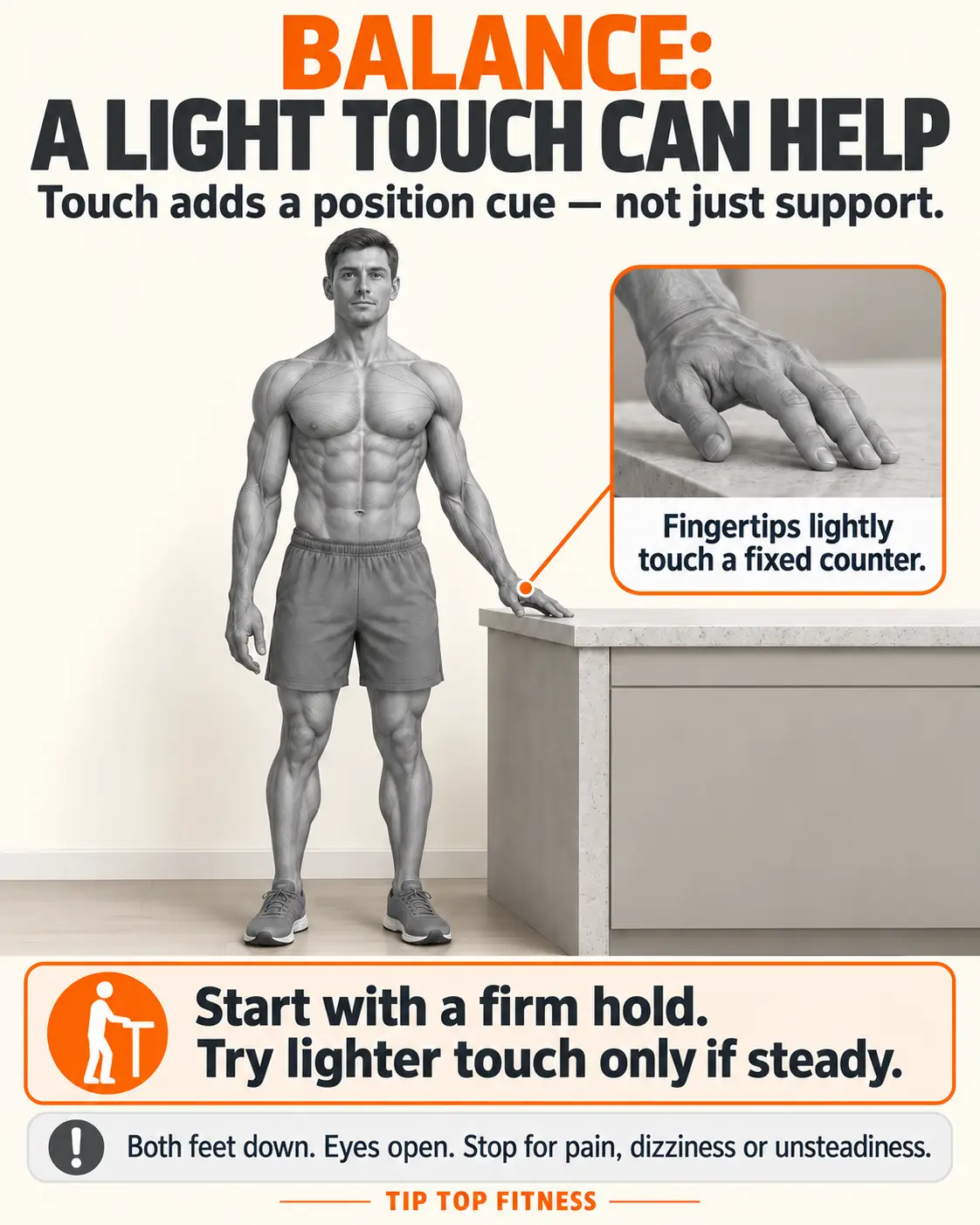
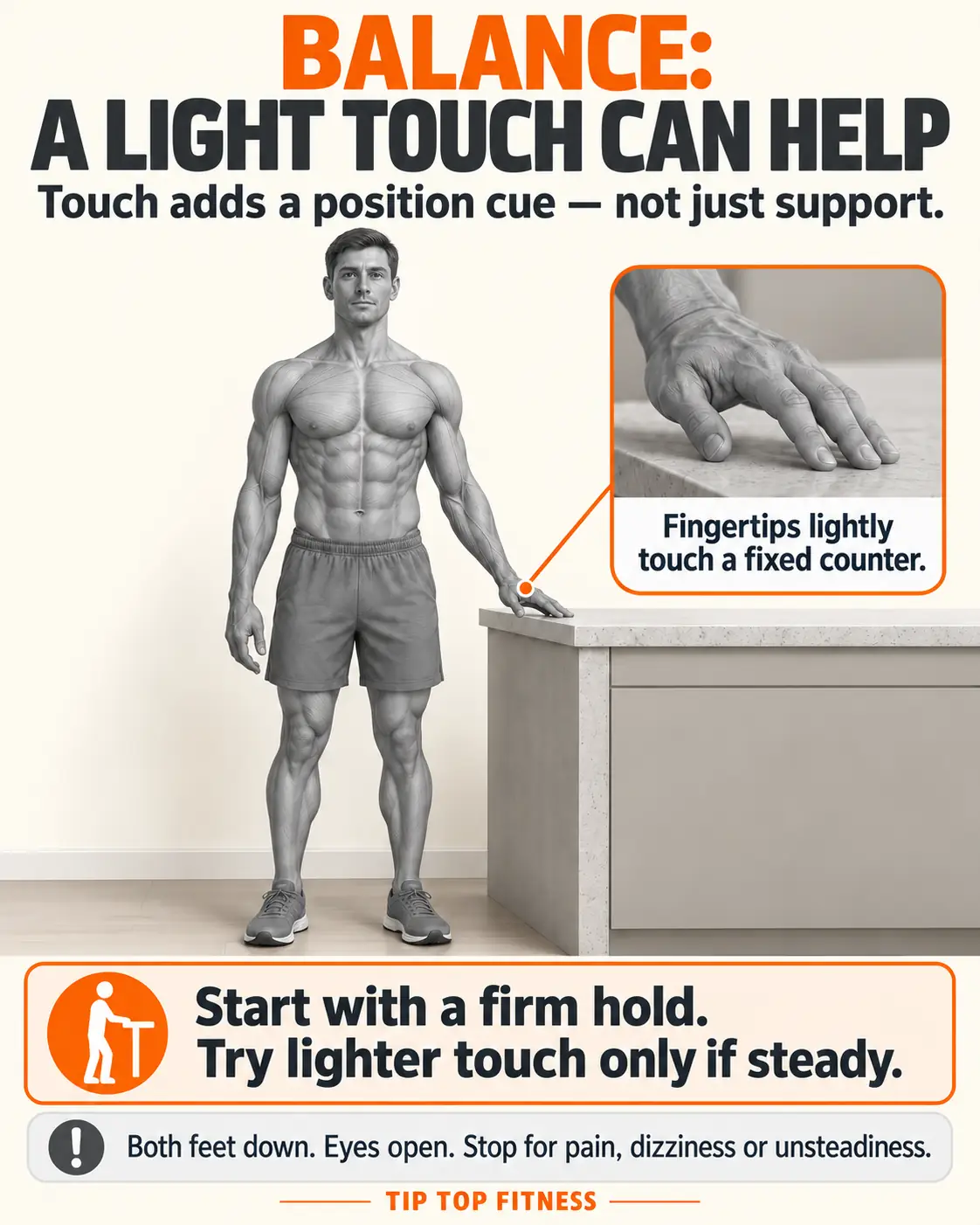
A fingertip can help steady standing even when it is not holding up much body weight. Touch gives your nervous system another cue about your position and small movements. That is why using support is not automatically “cheating” at balance practice—and why removing it is not always the best next step.
The useful distinction: information versus a firm hold
In a primary study by Jeka and Lackner, adults touched a rigid bar while standing in a narrow heel-to-toe position. Very light contact reduced sway despite being too small to act like a substantial handhold. The researchers interpreted touch as useful sensory information, distinct from physically counteracting sway with stronger force.
A 2018 primary study of 11 older and 11 younger adults also found less sway with light fingertip contact during a brief laboratory standing task. These were immediate sway measurements, not proof that this home comparison prevents falls or produces lasting improvement. You do not need to copy the narrow research stance, measure fingertip force or close your eyes.
Set up for control, not a wobble contest
Use a fixed kitchen counter or equally solid surface at a comfortable reach, with a dry, level, nonslip floor and secure footwear. Clear the space around you. Start with feet about hip-width apart, both feet flat, eyes open and a comfortable upright posture. Keep a firm hold with one or both hands as needed. South Tees NHS standing guidance uses a stable worktop and distinguishes two-hand, one-hand and fingertip support in its prescribed programme. That is not permission to remove support before you are ready.
Do not use a rolling chair, a door that can move, a loose towel rail or a light table. Choose a surface you can safely take hold of, not just reach with an outstretched finger. If ordinary standing is unreliable, you have recent falls or you have been given a walking aid or exercise restrictions, get individual guidance rather than experimenting with less support alone.
Try a small, supported comparison—only if already steady
Begin with a comfortable firm hold for a few normal breaths. Keep your feet and gaze in the same place. If you remain reliably steady, briefly ease the pressure to light fingertip contact without leaning or moving away from the counter. Keep your hand ready to take a firm hold immediately. Return to the firm hold, then rest. There is no need for a hands-free test, a stopwatch target or repeated attempts to prove a difference.
Notice whether standing feels controlled and whether the contact is useful. A visible wobble is not required. Your impression cannot measure sensory processing, strength or future fall risk. If the light-touch version feels uncertain, stay with the firmer hold; that is a useful adjustment, not a failed repetition.
Common mistakes and an easier option
Changing several things at once makes the comparison harder to interpret. Do not bring your feet together, lift a foot, turn your head or close your eyes while also reducing hand support. Avoid reaching so far that your body leans toward the surface. Keep breathing instead of bracing and holding your breath. The easier option is both feet comfortably apart and a firm two-hand hold—or skip the standing comparison and ask for help choosing an appropriate task.
When to stop
Stop for pain, dizziness, unusual breathlessness, slipping or a sense that you might lose balance. Take a firm hold and sit safely if needed. New or unexplained balance problems, repeated falls, recent surgery or medical exercise restrictions need advice from your treating clinician. This is general exercise education, not a balance assessment or rehabilitation prescription.
The takeaway worth keeping
Record the support, not just how long you stood: two hands, one hand or light touch describe different tasks. Support can provide both useful information and physical help. Choose the amount that lets you stay controlled; hands-free is not the automatic goal.
For related practice, see starting strength training after 60 and controlled calf raises. For a whole plan, explore personal training for older adults, beginner coaching or in-home training in Santa Barbara. Text Laurence using the button below about a $60 first full-hour session.