2026-10-28
Do you need heavier weights every week?
Adding a controlled repetition can progress a workout before you add weight. Learn how to compare like with like, use a rep range and recognize when to stop.
Tip Top Fitness · Training question · Guide 5
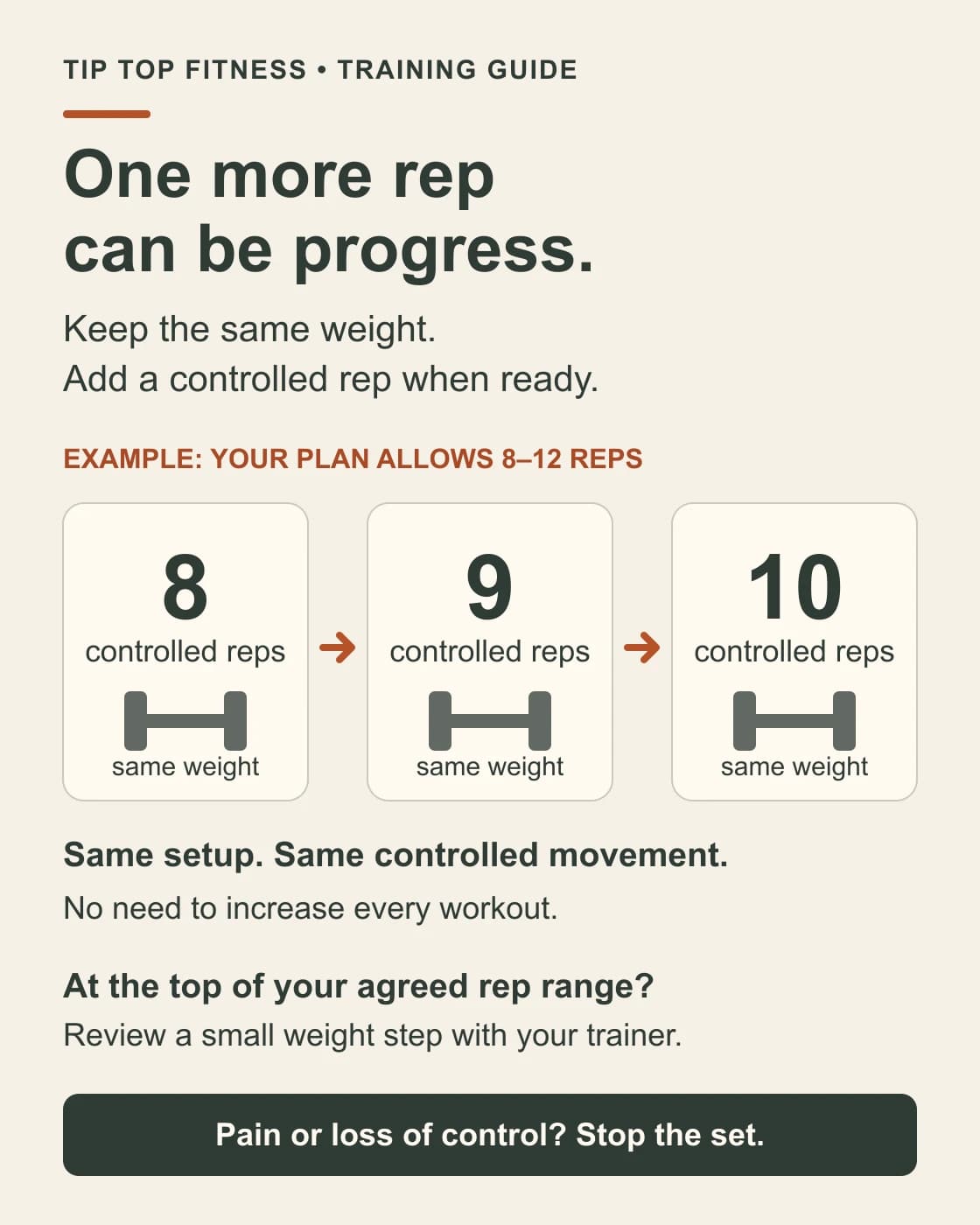
Adding one controlled repetition can progress a workout before you change the weight. Eight repetitions becoming nine can be a useful step—when the exercise, setup and movement stay comparable. You do not need to force a heavier dumbbell or a new personal best at every session.
Why repetitions can change the challenge
A repetition is one complete performance of an exercise. Doing another repetition with the same resistance adds work to that set. In a 2022 randomized study of 43 resistance-trained adults, researchers compared increasing load with increasing repetitions at a fixed load. Both approaches produced useful adaptations over eight weeks. This supports repetitions as a possible progression tool, rather than treating the weight alone as the whole plan.
The study used supervised lower-body training in adults with at least a year of training experience, with sets encouraged to muscular failure. It does not establish a universal beginner routine or guarantee identical results for every goal. The gentle planning example here is not a recommendation to copy that research protocol or train to failure alone.
Start with a repeatable setup
Choose an exercise you already know how to perform comfortably, using your existing plan or a trainer's guidance. Record the resistance, setup, repetitions and how the set felt. Keep the movement range and pace reasonably consistent so that the next session is a useful comparison. For a setup example, see the wall push-up guide before chasing a larger count.
Agree a repetition range appropriate to you. The diagram uses eight to twelve only as an example. Your range, number of sets, rest and starting resistance may be different. Begin with a resistance and repetition count you can control while breathing normally.
Try one small progression when ready
Suppose your plan allows eight to twelve repetitions. If eight are comfortable and controlled, a later session might allow nine with the same resistance and setup. There is no deadline: repeat eight if that is the suitable challenge today. A rushed or shortened ninth repetition is not the same task as eight controlled ones.
As the upper end of your agreed range becomes consistently manageable, review a small resistance increase with your trainer. You may then perform fewer repetitions. NIH guidance on keeping active describes gradually adding repetitions and reducing the count when adjusting to a heavier weight. The American College of Sports Medicine progression guidance also ties progression to ability and goals; it is not a demand to add weight on a calendar.
Common mistakes and an easier option
Avoid changing the weight, setup, pace and movement range together and then comparing only the final count. Do not bounce, hold your breath or rush through extra repetitions to make the log look better. Completing the same planned work with reliable control is a useful session even when the numbers stay unchanged.
The easier option is to keep the current resistance and repeat your manageable count, reduce the load, or use a simpler version your trainer has already shown you. Rest as planned. If the next available weight is a large jump, ask for another suitable option instead of forcing it.
When to stop the set
Stop for pain, dizziness, feeling faint or unwell, unusual breathlessness, or loss of control. Do not finish a target at the expense of comfortable movement. Persistent symptoms or medical exercise restrictions need individual clinical advice; this general guide cannot choose a rehabilitation progression for you.
A useful question for your next session
Ask: “What should stay the same, and what would tell us I am ready for the next step?” The takeaway is simple: record repetitions as well as resistance, and progress within a plan you can control.
For help planning that progression, explore strength training in Santa Barbara, beginner coaching or in-home training. Text Laurence using the button below about a $60 first full-hour session.